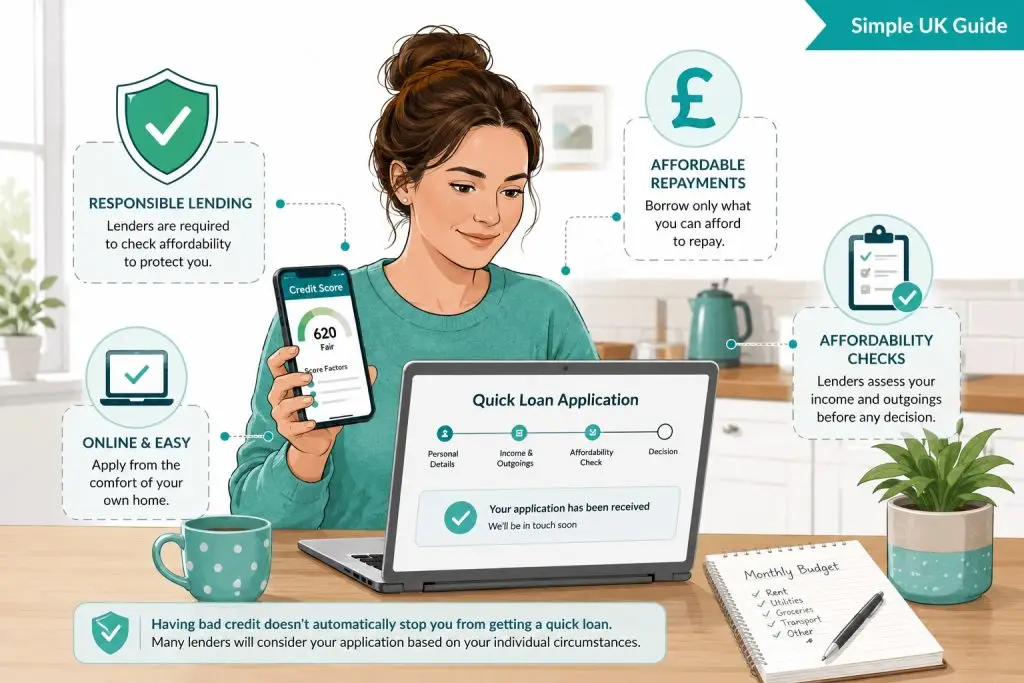
Having a poor credit history doesn’t automatically mean you can’t get a quick loan.
Many UK lenders understand that people’s financial circumstances change. Missed payments, defaults or County Court Judgments (CCJs) may affect your options, but they do not always prevent you from borrowing.
The key question most lenders ask isn’t simply whether you’ve had credit problems in the past. They also want to know whether you can comfortably afford the repayments today.
In this guide, we’ll explain how bad credit affects your chances of getting a quick loan, what lenders look for and how you can improve your chances of being accepted.
Can You Get a Quick Loan With Bad Credit?
Possibly.
Some lenders specialise in helping people with less-than-perfect credit histories, while others are willing to consider applications on an individual basis.
Every lender has different lending criteria, so being declined by one company does not necessarily mean you’ll be declined by another.
If you’re looking to compare lenders, visit our Quick Loans page to explore your options.
What Is Considered Bad Credit?
Bad credit can mean different things to different lenders.
Examples include:
- Missed or late payments.
- Defaults.
- County Court Judgments (CCJs).
- Individual Voluntary Arrangements (IVAs).
- Debt management plans.
- High levels of existing borrowing.
- A limited or very short credit history.
Some lenders may also take into account recent financial difficulties even if your credit score itself is reasonable.
What Do Lenders Look At?
Modern lending decisions involve much more than a simple credit score.
Lenders may consider:
- Your monthly income.
- Regular household expenditure.
- Employment status.
- Existing credit commitments.
- Bank account conduct.
- Credit history.
- Overall affordability.
Many lenders now use affordability assessments alongside credit reference information to build a more complete picture of your financial situation.
Does Applying Guarantee Approval?
No.
There is never any guarantee that a lender will approve your application.
Even if you meet the basic eligibility requirements, a lender may decide that the loan is not affordable or suitable based on its own assessment.
Responsible lending rules are designed to protect both borrowers and lenders.
How Can You Improve Your Chances?
While no one can guarantee acceptance, there are several steps that may improve your chances.
Borrow Only What You Need
Smaller loan amounts may be easier to repay and may be viewed more favourably than borrowing more than you genuinely require.
Complete Your Application Carefully
Simple mistakes such as incorrect addresses, employment details or income figures can delay an application or lead to unnecessary declines.
Be Honest
Always provide accurate information.
Lenders routinely verify many of the details supplied during an application.
Check Your Credit Report
Reviewing your credit report before applying can help you identify errors or outdated information that may need correcting.
Our Credit Repair guide explains practical steps you can take to improve your credit profile over time.
Can You Still Receive Money Quickly?
Possibly.
Having bad credit does not automatically slow down the application process.
Many lenders use automated systems that assess applications within minutes.
However, additional checks may sometimes be required, particularly where income or identity needs further verification.
Funding times also depend on your bank and when your application is submitted.
Should You Apply If You Have Bad Credit?
Only if the borrowing is affordable and genuinely necessary.
Before applying, ask yourself:
- Do I really need to borrow?
- Can I comfortably afford the repayments?
- Have I compared my options?
- Have I read the loan agreement carefully?
If you’re struggling with ongoing debt problems, free debt advice may be more appropriate than taking on additional borrowing.
Frequently Asked Questions
Can I get a quick loan if I have a low credit score?
Possibly. Some lenders will consider applicants with poor credit histories, although approval is never guaranteed.
Will a bad credit loan improve my credit score?
Making repayments on time may help build a positive payment history, although many factors influence your credit record.
Will every lender check my credit file?
Most lenders will carry out some form of credit assessment, although the type of search used may vary.
Can I get a quick loan with a CCJ?
Some lenders may consider applications from people with CCJs, depending on their individual lending criteria.
Do I need a guarantor?
Many quick loans do not require a guarantor, although this depends on the lender.
Can I be declined even if I have an income?
Yes. Lenders assess affordability as well as income, so approval is never guaranteed.
Is it better to apply with several lenders?
Making multiple applications within a short period can sometimes affect future lending decisions. Comparing your options before submitting a full application may be a more sensible approach.
Where can I improve my credit before applying?
Our Credit Repair guide contains practical information that may help you strengthen your credit profile over time.
Related Guides & Pages
- Quick Loans
- What Are Quick Loans?
- How Quickly Can I Get a Loan?
- Quick Loans vs Short-Term Loans
- Credit Repair
- Budget Calculator
- How It Works
External Links
- Financial Conduct Authority (FCA) – Information about borrowing money responsibly and understanding consumer credit.
- https://www.fca.org.uk/
- MoneyHelper – Free guidance on borrowing, credit scores and managing debt.
- https://www.moneyhelper.org.uk/en/everyday-money/credit/borrowing-money-and-credit