Secured and Unsecured Personal Loans Explained
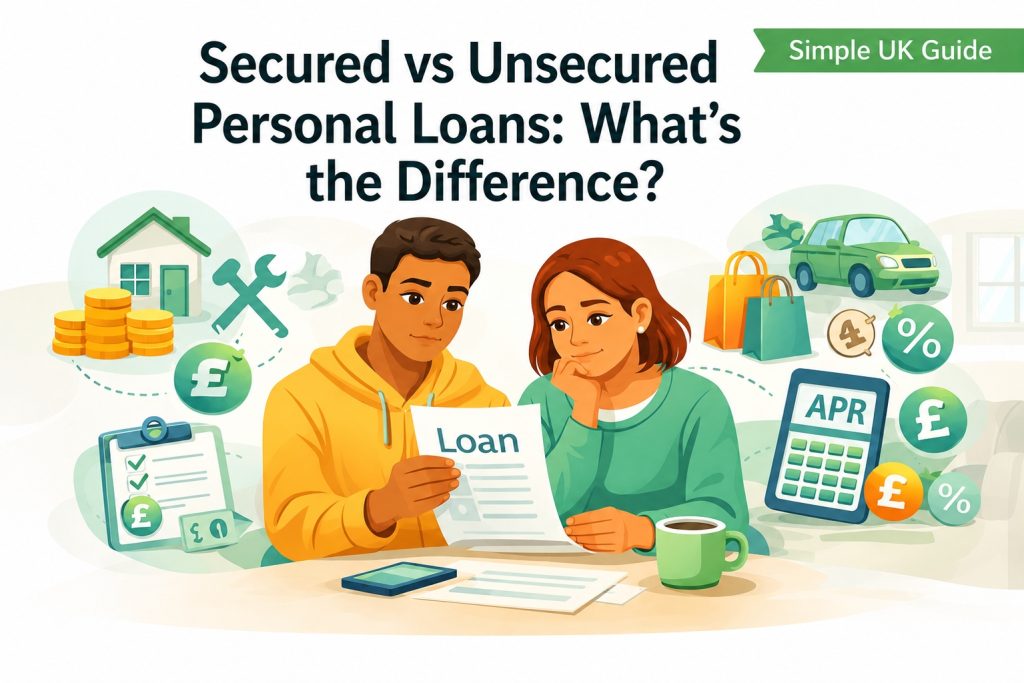
If you’re looking to borrow money, one of the first decisions you’ll come across is whether to choose a secured loan or an unsecured personal loan.
Both can be useful in the right circumstances, but they work very differently and carry different levels of risk.
When considering the differences between secured vs unsecured personal loans, it’s essential to evaluate your financial situation and needs.
Understanding the difference can help you choose the right type of borrowing for your situation and avoid expensive mistakes.
What Is an Unsecured Personal Loan?
An unsecured personal loan is a loan that does not require you to put up an asset as security.
You borrow a fixed amount of money and repay it in monthly instalments over an agreed period. The lender decides whether to approve your application based on factors such as:
- Your income
- Your employment status
- Your credit history
- Your existing financial commitments
- Affordability checks
Because there is no security attached to the loan, lenders generally view unsecured lending as carrying more risk.
For this reason, interest rates may be higher than on secured loans, particularly if you have a poor credit history.
Common Uses for Unsecured Personal Loans
People often use unsecured personal loans for:
- Home improvements
- Car repairs
- Debt consolidation
- Weddings
- Holidays
- Unexpected expenses
Many borrowers prefer unsecured loans because their home or vehicle is not directly at risk if they encounter financial difficulties.
What Is a Secured Loan?
A secured loan is a loan backed by an asset, usually your property.
The asset acts as security for the lender. If repayments are not maintained, the lender may have legal rights over the asset used as security.
Because the lender has this additional protection, secured loans often allow:
- Larger borrowing amounts
- Longer repayment periods
- Lower interest rates
Secured loans are commonly used by homeowners who need to borrow substantial amounts of money.
Common Uses for Secured Loans
Secured loans are often used for:
- Major home improvements
- Large debt consolidation projects
- Funding significant purchases
- Raising capital against property
Key Differences Between Secured and Unsecured Loans
| Feature | Unsecured Personal Loan | Secured Loan |
| Security Required | No | Yes |
| Homeowner Required | Usually No | Usually Yes |
| Typical Loan Amount | Smaller | Larger |
| Approval Based On | Income, credit and affordability | Income, affordability and security |
| Interest Rates | Often higher | Often lower |
| Risk to Property | None | Property may be at risk |
Which Type of Loan Is Easier to Get?
There is no universal answer.
Someone with excellent credit may find it straightforward to obtain an unsecured personal loan.
Someone with previous credit problems may find a secured loan easier because the lender has additional security.
Every lender has different criteria and approval is never guaranteed.
Which Type of Loan Is Safer?
In simple terms, unsecured personal loans generally carry less risk to your assets because there is no property attached to the borrowing.
With a secured loan, your home or other asset is being used as security. This means you should carefully consider whether the borrowing is affordable before proceeding.
Regardless of which type of loan you choose, you should always ensure that repayments fit comfortably within your monthly budget.
Can I Get Either Type of Loan with Bad Credit?
Possibly.
Many lenders will consider applications from people with less-than-perfect credit histories.
Factors such as:
- Current income
- Stability of employment
- Existing commitments
- Homeownership status
- Recent payment history
can all play a part in the lender’s decision.
How Do I Choose the Right Loan?
The right choice depends on your circumstances.
An unsecured personal loan may be suitable if:
- You want to borrow a relatively modest amount
- You do not want to secure borrowing against your home
- You have a reasonable credit history
A secured loan may be suitable if:
- You need to borrow a larger amount
- You own a property
- You understand the risks involved
- You are comfortable using your property as security
Końcowe przemyślenia
Secured and unsecured personal loans both have their place.
Neither option is automatically better than the other. The right choice depends on your circumstances, your borrowing requirements and your attitude to risk.
Before applying, take time to compare your options, check affordability carefully and make sure any borrowing is appropriate for your situation.
A little research today can save a lot of stress tomorrow.
You may also want to read our Guide to Personal Loans in the UK, and our article explaining a few things to consider when applying for an unsecured personal loan.
Często zadawane pytania
Is a personal loan secured or unsecured?
Most personal loans are unsecured. However, some lenders offer secured borrowing options, particularly for larger loan amounts.
Can I get a secured loan if I don’t own a home?
In most cases, secured loans require an asset such as a property to be used as security.
Are secured loans cheaper than unsecured loans?
They can be. Because the lender has security, interest rates are often lower. However, rates vary depending on the lender and your circumstances.
Which type of loan is best for bad credit?
There is no single answer. Some borrowers with poor credit may find secured loans easier to obtain, while others may qualify for specialist unsecured loans.
Does applying for a loan affect my credit score?
Many lenders now offer soft-search eligibility checks which allow you to see your options before making a full application.